
Liquid fuels – Petrol, Diesel, Furnace Oil, LSHS and Their Industrial Uses
Type of Liquid Fuels:
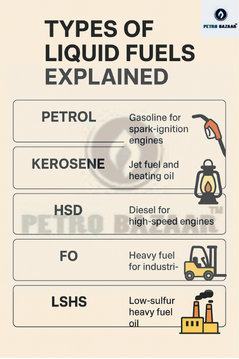
- PETROL
- KEROSENE
- HSD
- LDO
- FO
- LSHS
- RFO
what is Petrol ?
Petrol as fuel, also known as gasoline, is a volatile liquid hydrocarbon mixture used primarily in spark-ignition engines for vehicles
Petrol – what are the key properties?
It has a high-octane rating to prevent engine knocking, is highly flammable with a characteristic odor, and boasts strong volatility for easy air mixing in engines
What is Kerosene ?
Kerosene is a combustible hydrocarbon liquid distilled from petroleum, used mainly as a fuel for heating, lighting, and jet engines
Kerosene – what are the key properties ?
Kerosene has a higher flash point than petrol, making it less prone to accidental ignition during handling and storage. Its energy density and stability make it suitable for storage in bulk tanks and for use in simple wick or pressure burners.
What is HSD ?
HSD stands for High-Speed Diesel, a refined diesel fuel formulated for high‑speed, high‑RPM diesel engines such as those in cars, buses, trucks, locomotives and construction equipment
HSD – what are the key properties ?
Important properties include adequate cetane number (typically ≥45), low sulfur content, low ash and sediments, and a viscosity range that supports good spray characteristics in modern injectors. These features give HSD relatively clean combustion, good fuel economy, and compatibility with emission‑control systems compared to heavier diesel blends or residual‑containing oils
What is LDO ?
LDO stands for Light Diesel Oil, a medium-grade liquid fuel distilled from crude oil and used mainly in low- and medium‑speed diesel engines and industrial burners.
LDO – Key properties
LDO is more viscous and denser than HSD but lighter and less viscous than heavy fuel oil, so it can be used without preheating in most industrial systems. It usually has higher sulfur content, higher carbon residue, and lower cetane number than HSD, which leads to more smoke and deposits and slightly lower combustion efficiency
What is FO ?
FO typically means Furnace Oil, a heavy residual fuel oil used mainly in industrial boilers, furnaces, and some power plants for heat generation.
FO – Key properties
FO has high viscosity and typically needs preheating for pumping and proper atomization in burners, especially at ambient temperatures. It offers high calorific value, roughly in the 10,000–11,000 kcal/kg range, but also generally higher sulfur and impurity content than lighter fuels, leading to more stringent emission‑control needs
What is LSHS ?
LSHS stands for Low Sulphur Heavy Stock, a low‑sulfur heavy fuel oil used mainly in industrial boilers, furnaces, and power plants as an alternative to conventional furnace oil.
LSHS – Key properties
Because of its high pour point and viscosity, LSHS generally requires storage in insulated tanks and preheating for pumping and proper atomization in burners. Its low sulfur content helps reduce SOx emissions and deposits compared with standard furnace oil, while its calorific value (around 10,000–10,200 kcal/kg) supports efficient industrial heat generation.
What is RFO ?
RFO stands for Residual Fuel Oil, a heavy, low-grade fuel derived from the residue left after distilling crude oil. It’s commonly used in industrial boilers, ships, and power plants due to its low cost
RFO – Key properties
Residual Fuel Oil is viscous and requires preheating for pumping and burning, often reaching temperatures of 104–127°C. It contains impurities like sulfur and is known as No. 6 fuel oil, Bunker C, or heavy fuel oil
The primary components of a fuel
- CARBON : C
- HYDROGEN : H
- SULPHUR : S
- NITROGEN : N
- OXYGEN : O